

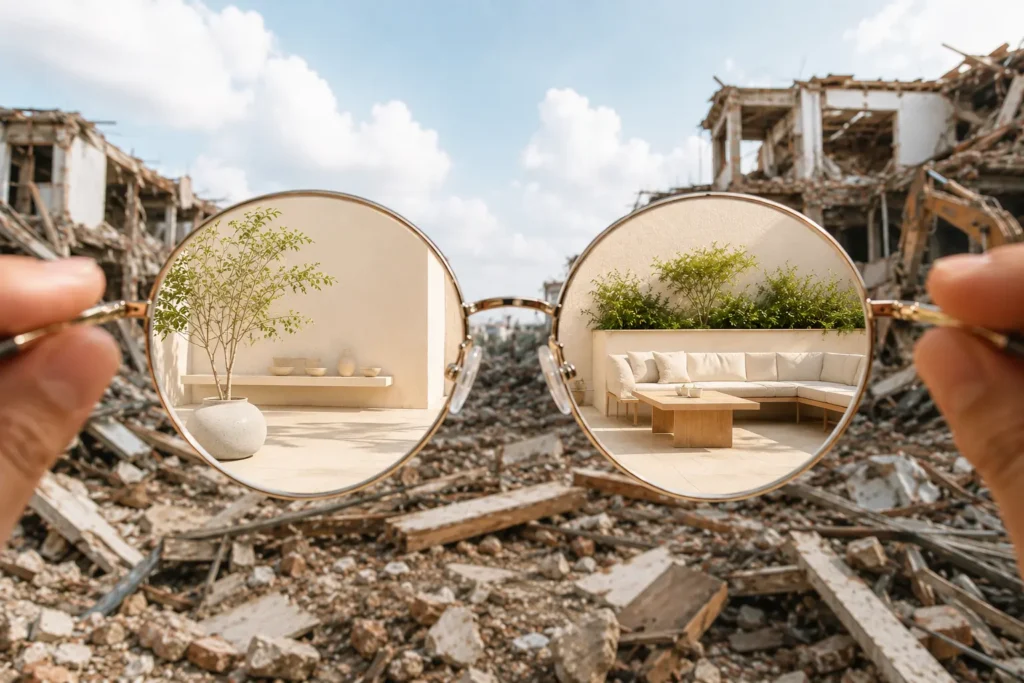
The wallpaper has been installed incorrectly. Twice. Now a third installer is booked, and you’re watching the calendar, watching the client, and wondering how many more things can go wrong on a single job.
Every designer who has been in the field long enough has had a project like this: one where the normal logic of preparation, sourcing, and professional management stops working. The tile order arrives with mold. The custom piece is the wrong size. The vendor goes quiet. One problem surfaces, three more you didn’t know you had. Interior Design Community asked the community about it, and the response was immediate, visceral, and full of real professional experience.
What separates a so-called “cursed” project from a difficult one isn’t just the volume of problems. It’s the cascading quality: each failure opens a door to another, and the project keeps expanding in scope, cost, and time in ways nobody planned for when the contract was signed. That expansion is where the professional and business risk lives.
Understanding what that risk looks like and what the most experienced designers do when they’re in the middle of it is what this post is about.
Why Cascading Project Failures Hit Differently Than a Single Delay
A delayed shipment is a logistical problem. You call the vendor, update the client, and adjust the installation sequence. It’s frustrating but contained.

What happens in a problem project is different. The first setback shifts the client’s posture. Instead of trusting the process, they start watching it. They begin tracking lead times on their own, asking questions they didn’t ask before, and interpreting routine delays through a newly skeptical lens. This is not irrational on their part. Once something has gone wrong, it is reasonable to wonder what else might.
The logistical and the relational are now running on parallel tracks, and you have to manage both at once.
This matters for your business because the professional risk in a cascading project is not just about cost absorption or timeline slippage. It’s about whether the client relationship survives the project intact. A client who ends a difficult job feeling informed, cared for, and respected will refer you. A client who ends a difficult job feeling blindsided or misled will not, regardless of how beautiful the finished room is.
“If one thing goes wrong, it seems to be a domino effect… also, some clients subconsciously ‘look for problems’.”
@laurazbdesign
That second observation is worth sitting with. The domino effect is logistical. You can trace it, address it, and document it. The client who starts looking for problems is a relational challenge that requires a different kind of response, one built on communication strategy rather than problem-solving. IDC’s guide to managing the emotional landscape of designer-client relationships goes deeper on how to navigate this dynamic.
How Client Mindset Shapes a Project’s Trajectory
Several designers in this conversation pointed to a pattern that experienced practitioners will recognize: the projects that experience the most disruption often involve clients who were already anxious, controlling, or difficult to reassure before the first problem appeared.
This is not a blame-the-client argument. Difficult things happen on good projects with good clients. But the pattern carries a real practical implication: a client who enters the project with a high need for control adds a layer of management complexity on top of whatever logistical problems arise. When something goes wrong, they are more likely to escalate, more likely to interpret a delay as negligence, and more likely to need extensive reassurance before the project can move forward.
“The law of attraction is real and the clients who are most neurotic and difficult to deal with often have the most unusual issues with their project. That’s not to dismiss that bad things happen to good people. But anytime we’ve had a project with an unusual amount of activity that is beyond our control such as shipping damage, item defects, trade delays etc, it’s always with the clients who are fixated on trying to control and manipulate. Our clients who trust and allow their projects to unfurl with ease are the projects that have the smoothest journey.”
@curatedbychrissy
The business application here is about client selection and pricing. A client who demonstrates high anxiety or control-seeking behavior during discovery is telling you something important about the project management overhead you should expect. You don’t need to decline every anxious client, but you do need to price accordingly, build in more communication touchpoints, and set expectations with particular care during onboarding.
The time you invest in managing a high-anxiety client through a difficult stretch is time you should have budgeted for when you signed the contract. If you didn’t, that’s the data point you take into your next discovery process and your next proposal.
What a Truly Cascading Project Looks Like
It helps to name the actual scope of what problem projects can involve. The word “issues” undersells it. One designer’s account from this conversation gives a realistic picture of what happens when a project genuinely goes off the rails:
“I thought I was the only one!! On one project, half of my bathroom tile had red mold all over it, which we didn’t discover until the day of install. And it was the last available lot of a discontinued line. The custom 7′ tall wardrobe mirrors cracked after install. The custom marble trough sink leaked twice after installation and had to be removed from its inset position in the wall and taken back to the shop for repair. The roughs for the sink were installed upside down. The cast iron tub which we got at a waterworks clearance sale for next to nothing was the wrong size, a detail determined only after it had received its custom paint job and been installed — had to find a new one (triple the cost), have it repainted and delivered, and the old one sold. I gotta stop… the PTSD panic is brewing.”
@studiomhli
This is an extreme example, but every element of it represents a real category of failure that any designer could face: a material defect discovered at installation, a discontinued product with no available substitute, a custom piece that fails post-install, a vendor error in the rough-in work, a sizing issue that only becomes apparent after costly fabrication. These are not edge cases. They are the categories your contract, your vendor relationships, and your project documentation either protect you against or leave you exposed to.
The question worth asking before your next project begins is which of these scenarios your agreement addresses, and which would leave you absorbing unbudgeted costs. If the answer is uncertain, a conversation with a business attorney who works with creative professionals is worth having. IDC’s overview of must-have interior design contract clauses is a useful starting point.
Educational content, not legal advice.
When to Stop Trying to Fix Everything and Start Managing the Reality
One of the most revealing things in this IDC community conversation is how many experienced designers described a conscious decision to stop trying to make a problem project smooth and start trying to survive it professionally intact.
“Sadly, YES! For me, once I realized it was cursed, I lowered my expectations that anything would go right and released wanting to control the outcome. It’s so disappointing but you have to know when to protect your sanity.”
@mariematthewsinteriors
This is not defeatism. It is professional triage, and it carries a real business rationale. Designers who maintain the expectation that they can engineer a smooth outcome when the fundamental conditions have changed tend to make a specific set of errors: they absorb costs they shouldn’t, they promise timelines they can’t meet, and they take ownership of outcomes that were never within their control. Those errors compound the original problems and create new liability.
Shifting to a triage mindset means asking different questions. Not “how do I make this project perfect?” but “what do I need to document, communicate, and deliver to protect the client relationship and my professional standing, even if the project itself is messy?” That shift lets you stay calm, stay visible, and stay useful to the client. It keeps the relationship intact even when the project can’t be saved from its own complexity.
A few things become clearer in triage mode. Documentation matters more than it did before: every vendor communication, every change order, every client approval email is now an important record. Communication frequency needs to increase even as the news gets harder to deliver. And the scope of what you will personally absorb needs to be defined honestly, both for yourself and ultimately for the client if the situation requires that conversation.
The Communication Strategy That Holds the Client Relationship
The designers who described getting through problem projects with their client relationships intact shared a common thread: they anticipated the client’s emotional state rather than reacting to it. They communicated before the client felt left in the dark.
Anticipating worry before it turns into blame is the core skill, and the best moment to use it is at the point of placing the order, when the client is still in a forward-looking, agreeable headspace.
“I tell clients when they’re ordering furniture to forget that it ever happened and that then when I call you to schedule the install they’ll be pleasantly surprised. It usually makes them laugh and know not to take things too seriously ie WORRY. It’s the worriers that you have to worry about. Nip that in the bud! No negative thinking!”
@karena.may
The humor in this approach is deliberate. By setting the expectation at the moment of order, before the client has had time to build a mental timeline and start tracking against it, you take the schedule off the table as a source of anxiety. When delivery takes longer than the stated lead time, the client isn’t surprised, because you told them not to track it.
This works best as a standard practice, not a reactive one. A few specifics that support it:
At the time of order placement, clearly tell clients that lead times are estimates, not guarantees. You will manage the logistics and notify them of any changes. They do not need to follow up independently.
Send brief project status updates on a regular schedule, even when there is nothing new to report. “Everything is in transit, no flags this week” takes five minutes to send and prevents the anxious email that arrives when silence runs too long.
When something does go wrong, be first. Call or message the client before they find out on their own. Clients who hear difficult news from a designer they trust respond very differently from clients who feel they had to pry the information out. The conversation you initiate is almost always easier than the one you end up reacting to. IDC’s guide on how to communicate vendor delays clearly and professionally covers the specifics of delivering that news well.
What a Hard Project Teaches You About Your Business
Every designer who has survived a project like this walks away knowing things they didn’t know going in: about their vendors, their contracts, their client selection process, and their own capacity for professional steadiness under sustained stress.
The designers who end difficult projects with loyal clients are the ones who stayed honest, stayed reachable, and gave the client a consistent sense that someone was in charge of their interests, even when the project was out of anyone’s control. That steadiness is not a personality trait. It is a set of systems and decisions made before the problems started.
The contract provisions, the communication workflows, the expectation-setting during onboarding: these are the tools you build before you need them. When a project turns, they give you a foundation to stand on while everything else is shifting. Designers who have built them tend to emerge from hard projects with stronger client relationships than the ones they started with, because the client saw exactly what they got when things were genuinely difficult.
That is the business case for treating project management infrastructure as a priority, not just a nice-to-have. You don’t build it for the easy projects. You build it for the ones that aren’t.