

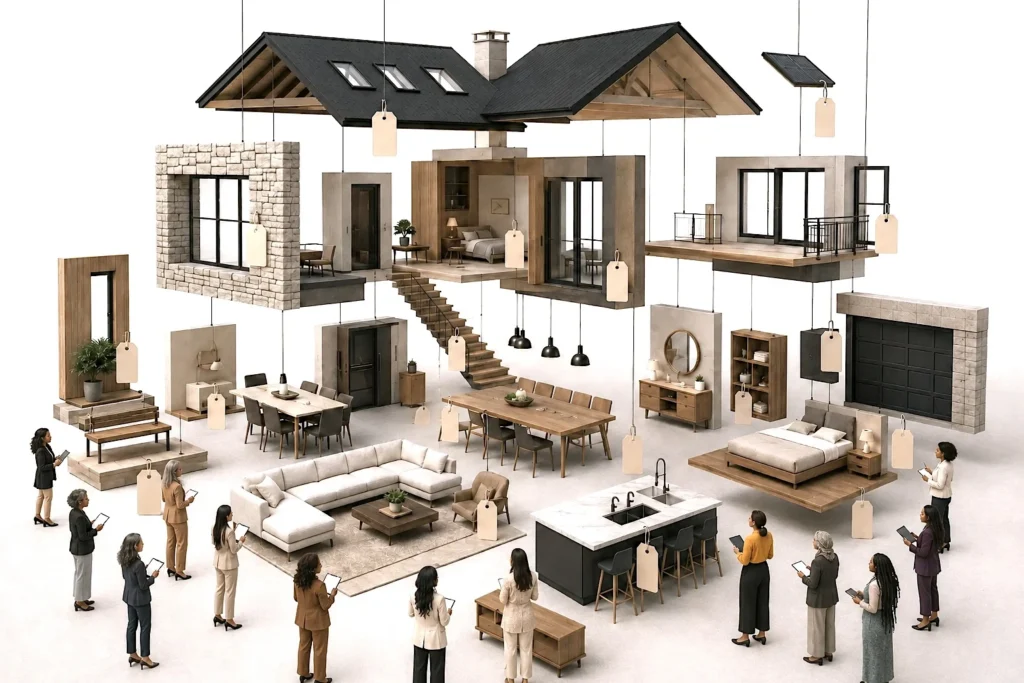
A client walks into a consultation for their brand-new 5,000-square-foot build. They have watched every season of every renovation show on cable. They have a Pinterest board with 400 pins. And they have a number in their head, “a number they believe is reasonable,” that has almost nothing to do with what it will actually take to furnish the home they have just described to you.
This is not a new problem. But the gap between client expectation and market reality has widened considerably in recent years, and the interior design community is starting to push back. When Interior Design Community asked designers what the cost breakdown would realistically be to furnish a 5,000 sq ft new build for their average client, the answers poured in from across the country. They ranged from $130 per square foot to well over $1 million, depending on market, quality level, and project scope.
That spread is not a problem. It is the point. Understanding why those numbers vary and learning to communicate them clearly are among the most valuable skills a working designer can develop.
Why Sticker Shock Happens in the First Place
Clients are not unreasonable. They are uninformed, and there is a meaningful difference.
Most homeowners replace quality furniture every five to ten years. They are not regularly exposed to current market pricing. They have no frame of reference for what a fully furnished room costs at the standard a professional designer works to, let alone twelve of them.

“People don’t shop for new furnishings all that often. It’s not like anyone is out buying a new sofa every year statistics show that quality furniture is typically replaced every 5-10 years. A lot can change in that span, both in the market and in people’s lives. Those conversations about cost can feel uncomfortable at times, but they matter. Being honest about the real price of things keeps clients informed and grounded in reality whether they like it or not.”
@carter_averbeck_interiors
The discomfort designers feel in those conversations is real, but it often stems from a misread of the situation. Clients are not resisting the number because they cannot afford it. They often resist it because they have never heard it before. Your job is to normalize it early and to give them a framework that makes the number make sense.
The To-The-Trade podcast has explored this directly, the principle that clients need clear communication on timelines, price expectations, and process before they can truly commit to a project. When designers skip that conversation early, they pay for it later in scope disputes and client dissatisfaction.
The Cost Breakdown Designers Are Actually Using
There is no universal answer to what a 5,000 sq ft furnishing project costs. But the IDC community offered a range of real benchmarks that reflect how different designers approach the conversation.
“We always tell our clients to budget $200/SQFT for furnishings not including art. So a 5,000 SQFT home needs $1 Million + to furnish.”
@eckstromstudio
That number reflects a certain market and quality tier, but it also reflects something more important: a consistent, confident message delivered to every client before a project begins. The number may vary by region or scope, but the habit of having one does not.
“These days? $130/square foot minimum if I include design fees. This is based on my baseline standard of quality and would include what I consider entry-level vendors (Four Hands, Hooker, Uttermost, etc.) It goes up from there. When I started in design 20+ years ago, I remember we were quoting people $75/sq. ft. minimum. This also depends on how much designers are charging for ‘markup’. I charge retail prices.”
@oliviawestbrooksinteriors
That $75 to $130 per square foot shift over twenty years is not just inflation. It reflects changes in freight costs, post-pandemic supply chain disruption, increased tariffs, and a furniture market that fundamentally repriced itself between 2020 and 2025. When a client questions your numbers, that kind of historical framing can reground the conversation.
For projects in the middle range, @hudsonhome offered a tiered breakdown that gives clients context at multiple quality levels: $300,000 to $350,000 for a mix of ready-made and custom; $350,000 to $500,000 for more custom work and higher-end lighting; $500,000 to over $1 million for fine finishes, textiles, top-tier furniture such as Holly Hunt, and premium custom lighting and decorative accessories. This kind of tiered framing is useful in early client conversations. It does not ask the client to commit to a number. It shows them what different investment levels look like in practice, and it lets them self-select into a range that reflects their actual priorities.
What the Per-Square-Foot Formula Misses
The per-square-foot estimate is a useful starting point, but several designers in the IDC discussion pointed out that it can create a false sense of precision if used without qualification.
“I have done so many huge custom homes and this question needs a lot more qualification. Some clients could spend 7 figures on art alone. Where is this located? How many floors? How many spaces? What is the style? I have never in 21 years used a sq foot or percent value of the house to calculate what the furniture will cost. I think a more accurate question is…How much would it cost to furnish a high end bedroom with a sitting area excluding art?
How much would it cost to furnish a dining room that seats 12 with 8 ft of windows that need curtains? Window treatments could vary by $100-200K depending on style and function. Too much nuance to say it’s ____amount. In Atlanta and DC suburbs the lower level could cost big bucks because you have bars, wine cellars, theater rooms, golf simulators, pool tables, exercise rooms, etc.”
@kristindrohan
The implication for designers is this: the per-square-foot number starts the conversation. The room-by-room breakdown closes it. Starting with a benchmark tells a client whether the project is in their range at all. The detailed scope review that follows is where the real budget gets built.
@creativetonic added another layer that often gets buried in the headline number. Are designers factoring in procurement time, pre-installation supervision for drapery, rugs, and wallpaper, plus shipping, freight, inspection, storage, moving, delivery fees, and installation oversight? The furniture line item is what clients think about.
The procurement overhead, the freight, the storage, the white-glove delivery, these are what designers know. Getting clients to understand that the furniture number is not the full project number requires making those line items visible early. According to Furniture Today, the cost of residential furniture has increased significantly in recent years, making it even more important to set accurate expectations from the start.
How Designers Use These Numbers to Protect Their Time
There is a reason designers share furnishing benchmarks publicly. It is not just education. It is also a filter.
“The biggest reason having a realistic range (say $200/ft) is because it helps you weed out a potential client who has unrealistic expectations. We often try to start this conversation very early because we’ve been told by the client what they want it to be, and phrased as nicely as possible, I’m a decorator not a magician.”
@danielledrollins
The client who comes in expecting a fully furnished 5,000 sq ft home for $80,000 is not a bad person. They are a client whose expectations were shaped by reality television and influencer content that rarely discloses actual project costs. But they are not a client you can serve well if they cannot adjust their expectations, and the earlier that mismatch surfaces, the better for everyone.
Some designers tie the estimate to home value rather than square footage. @lanotthecity uses 15 to 20 percent of the home’s value as a starting benchmark, enough to orient clients before any detailed scope work begins. @southernantiques works with a higher ratio of around 40 percent, which provides a quick guesstimate before custom work or an art program pushes that number up.
A $2 million home client who hears “15 to 40 percent of the home’s value for furnishings” can quickly calculate a working range and self-assess whether the investment is realistic for them before a single proposal is written. These percentage models are worth keeping in your back pocket even if you ultimately build room-by-room estimates.
For a framework on how to confirm budget alignment before construction pricing enters the picture, see the IDC post How Interior Designers Confirm Project Budget Before Construction Pricing.
What the Media Gets Wrong
One of the most practical observations in the IDC discussion connected client budget misinformation directly to television production.
“I’m thinking the number would be 375k or higher. Interestingly, HGTV’s Rock the Block puts the number at 275k for a drywalled 5,000sq foot home with completely bare floors. But when you consider all the sponsored furnishings the show receives, that number is grossly inaccurate. Shows like this are how consumers are arriving at their numbers. I think that’s important to know.”
@jadoreledecor
This is not a small point. The clients who walk into your office with unrealistic budgets have often been educated, if you can call it that, by productions that receive significant sponsorship product. They are comparing their project to a number that was never real.
Knowing this does not make the conversation easier, but it gives it a different shape. You are not correcting a client who is being difficult. You are filling in information they genuinely did not have. That framing makes the conversation feel less like a confrontation and more like part of the service.
Sharing Real Numbers Is an Act of Professional Leadership
The IDC community’s willingness to share real numbers publicly is itself a form of industry advocacy. Every designer who openly discusses what large-scale furnishing projects actually cost makes it marginally easier for the next designer to have that same conversation with a prospective client.
The benchmark you use, whether it is $130 per square foot or $200, whether it is 15 percent of home value or 40 percent, matters less than the habit of using one. Lead with a realistic range early. Use the tiered breakdown to give clients context. Make the procurement and logistics costs visible before they become a surprise.
The clients who are the right fit will stay. The ones who are not will tell you sooner rather than later. Either outcome serves your business better than a project that starts without honest numbers on the table.