

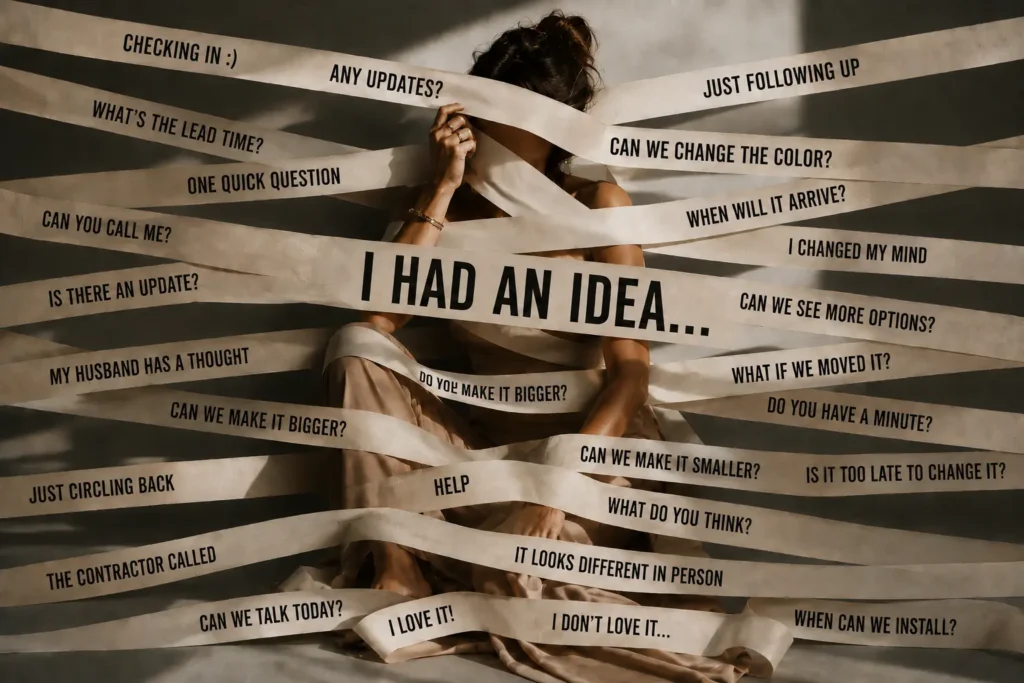
Client texts don’t feel like a business problem until they are. The message about the fabric sample arrives at 7:42 a.m. Another at 10:15 asking about the timeline. A third at 2:30 with a photo of something the client spotted on Instagram. Each one takes a few seconds to read and a few minutes to answer, but that’s not really the cost. The cost is what happens in between: the derailed thought, the lost thread, the design decision that takes twice as long to reach because attention was sliced in half by a notification.
Research on cognitive interruption suggests it takes 15 to 20 minutes to fully return to focused work after a distraction. That’s not an exaggeration for interior design, where the thinking is spatial, contextual, and layered. One client text in the middle of a sourcing session doesn’t cost three minutes. It can cost the rest of the hour.
Building clear communication expectations with new clients before a project begins is where this work pays off most. The To the Trade episode with Shannon Ggem on boundary-setting and structured client communication is a practical place to start if you’re working out what those policies should look like.
Interior Design Community recently put this question to its members: how are you handling client texts, and how, if at all, are you charging for them? The responses covered billing systems, communication policies, technology infrastructure, and a few frank admissions about what happens when you don’t have a policy at all. What emerged wasn’t one right answer. It was a clear picture of the decisions working designers are making to protect their time, their billing, and their sanity.
Why Every Client Text Costs More Than You Think
The disruption cost is real, and it compounds. A client who texts three times a day isn’t generating three interruptions. They’re generating three focus resets, three documentation gaps (if you aren’t capturing that communication somewhere), and three moments where your professional boundary either holds or starts to erode.

There’s also a billing dimension that most designers undercharge for, or miss entirely. If you’re hourly, text responses are time. If you’re flat-fee, texts that generate decisions, changes, or client-driven revisions are in scope. And if you’re not tracking or charging for either, you’re subsidizing your client’s preferred communication style with your own time and revenue.
The designers who responded to this question have largely landed in one of two camps: charge for texts the same way you charge for any other correspondence, or remove texting from the project communication stack entirely. Both approaches work. The mistake is having no approach at all.
Two Systems That Actually Work
The first approach is to treat a text like any other billable communication. If you charge hourly in 15-minute increments, a text gets a 15-minute unit. If three arrive in the morning, that’s three units, unless they’re close enough together to be grouped under one.
“In my contract, texting is called out as a form of communication. And since I charge hourly, billing in 15 minutes increments (I’m a former accountant, hence the 15 mins.), it gets billed the same as an email, or any other correspondence would.”
@thewraydesignco
This approach has an elegant logic: if it requires your professional attention, it’s billable. It also creates a natural incentive for clients to consolidate. When every individual text costs a unit, clients tend to batch their questions into emails instead.
The second approach is to take texting off the table for anything substantive. Texts are for logistics (confirming a delivery window, flagging a last-minute arrival) and nothing else. Anything that involves a decision, a question, or a response that needs to be tracked moves to email.
“We keep texting with clients limited to quick logistics only, arrival times, drop-offs, etc. All actual project communication and decisions move to email so everything stays organized and documented (and easier to bill properly for).”
@lamposdesign
This approach protects documentation as much as billing. Project decisions made over text live in a phone app, not a project file. When a client later says they don’t remember approving something, a text thread is a poor substitute for an email chain with timestamps and clear language.
The same documentation discipline applies whenever client decisions need a traceable record. Here’s how designers approach documenting client decisions to protect against future disputes, including when vendor issues put approvals in question.
If You Bill for Texts, Here’s How to Build the Infrastructure
Billing for texts only works if you have the right tools in place. The first is separation: your personal cell number should not be your client number. Several designers in this thread made this point clearly, and the reasoning goes beyond personal boundaries.
“I do not give my personal cell phone number to my clients. I bill in 15 minutes increments for texts, but I bill so that every text = 15 minutes, BECAUSE every text has to then be documented in a way that can be tracked if needed later on. We have a VOIP line that accepts texts, and we typically reply to them via email.”
@waldron_designs
A VOIP line (tools like Google Voice, OpenPhone, or Grasshopper) gives you a dedicated business number that accepts texts, logs communication, and can be turned off outside business hours. When a client texts that number, you have a documented record in your business system, not in your personal messages app. You can reply via email, which keeps the response trackable and professional.
The second piece is documentation. If you bill for a text, that billing needs to be defensible. Log it the way you would any time entry: date, duration, brief description (“client text re: fabric selection, response sent via email”). If you use project management software, many platforms have time-tracking features that accommodate this kind of entry without friction.
Making Email the Default Without Making Clients Feel Managed
The designers who use an email-first policy almost universally say the same thing: it has to be established before the project starts, not mid-project when a client is already texting you daily.
The key is framing. “Please don’t text me” lands very differently than “Here’s how I work, and here’s why it protects your project.” The business case for email (documentation, billing clarity, and response quality) is a genuine client benefit, not just a designer preference. Present it that way.
“Since our design part is a flat fee we dont charge for quick texts. Sometimes I want the answer quickly too. But once we enter the hourly project coordination/construction phase, we do charge hourly and I would charge at that point. I do tell clients I prefer email for proper record keeping AND my 9-5pm hours are clearly stipulated. I also tell clients that number is business line and turned off after 6pm and weekends.”
@ivonnevalencia_design
Note the phase-based nuance here. A flat-fee design phase might tolerate quick texts without billing implications. An hourly project coordination phase does not. The policy doesn’t have to be identical throughout the engagement, but it does have to be communicated clearly at each stage and, ideally, written into the contract before each phase begins.
When a client texts outside the parameters you’ve set, redirect without escalating. “Got your text for anything that needs a documented response, shoot me an email, and I’ll address it during business hours.” One sentence. Consistent redirection builds the habit faster than any amount of explaining.
What Your Contract Needs to Say Before the Project Starts
Billing for texts and restricting communication channels only holds up if it’s in writing. Several designers in this thread mentioned their contracts explicitly, and the specifics matter.
At minimum, your contract should address communication channels (which are approved and for what purposes), response times and business hours, and billing units for any communication that’s tracked as time. If the text is limited to logistics, say that. If text is billed at the same rate as any other correspondence, say that. If your business line is unavailable after 6 p.m. and on weekends, say that too, so a client can’t later claim they expected an immediate response.
Some designers go further. One commenter in the thread noted that after-hours or weekend texts are billed at double the standard rate. That’s a defensible policy if it’s clearly stated in the contract, but it should be reviewed with your attorney or business advisor before you implement it, since rate structures for after-hours contact can involve legal nuances depending on your jurisdiction and business structure.
Educational content, not legal advice.
For a broader look at what your design contract should cover, this IDC guide on design contracts and insurance walks through the protections designers often overlook until something goes wrong.
The Phone Itself Is Part of the Policy
A few designers made a point that’s easy to overlook: the technology you use shapes client behavior. A personal cell number handed out freely signals availability. A dedicated business line with defined hours signals a professional practice.
“I have two cell phones, one for business and one personal. My business line goes into night mode automatically and I also leave it in my office overnight and on weekends (I check it periodically). It’s really helped me preserve my sanity and boundaries, while also allowing my clients to freely text me as is custom in 2026.”
@lindsellinteriors
This setup is worth considering for what it accomplishes on both sides. The designer preserves personal time because the phone is physically elsewhere. The client can still text a business line freely within defined hours and doesn’t feel shut out or managed. It’s a structural solution to a behavioral problem.
The same logic applies to after-hours notifications on any device. If client text notifications are arriving on your personal phone at 10 p.m., you will either respond or feel the pull to respond. Either outcome is a boundary problem. The fix is structural: a separate number, a scheduled do-not-disturb window, or a project portal where clients submit requests that you address on your schedule.
What This Is Really About
There’s a layer to this conversation that goes beyond invoicing. Some texts aren’t about project decisions, they’re about client anxiety. The client who sends four messages in the morning isn’t necessarily demanding. They may be nervous about a significant financial commitment and are looking for reassurance that things are moving forward.
“I don’t mind simple chats and the occasional brainstorming, but when it’s clearly dysregulated spiraling, that’s a ‘hey, I don’t want anything to get missed. Please put all your concerns into a single email and send it out to me later today so I can address everything.’ It’s not billing, it’s client management.”
@nbaxter.design
That distinction matters. A client who is genuinely anxious may need a brief reassurance call more than they need to be redirected to email. Reading what’s actually happening (nerves, confusion, a legitimate question fragmented across five texts) changes how you respond and what actually helps.
The most effective communication policies account for this. A rigid “no texts, email only” rule is efficient. But applying efficiency without judgment can damage trust at the moments when it matters most. The policy is a default, not an override for professional judgment.
What the most experienced designers in this thread share is consistent structure paired with flexible execution. The contract states the approved channels. The billing reflects the time. And the designer reads the client well enough to know when a quick text back is actually the right call, and to decide that consciously, rather than by default.
That’s the difference between having a texting policy and having a communication practice.
Find IDC content more easily in Google
Set Interior Design Community as a preferred source in your Google settings and we’ll show up more often when you search. It takes less than a minute.
Add IDC as a preferred source →