



To-The-Trade Episode Summary
25 Years in the Trade, and One Clear Lesson
Ann Feldstein has spent more than 25 years in the interior design industry. She started at Kravet, Inc. in 2000, spent 15 years there rising to vice president, and in 2015 launched Moxie Marketing, a firm built on the idea that women in the trade can accomplish more when they stop competing in silence and start sharing what they know.
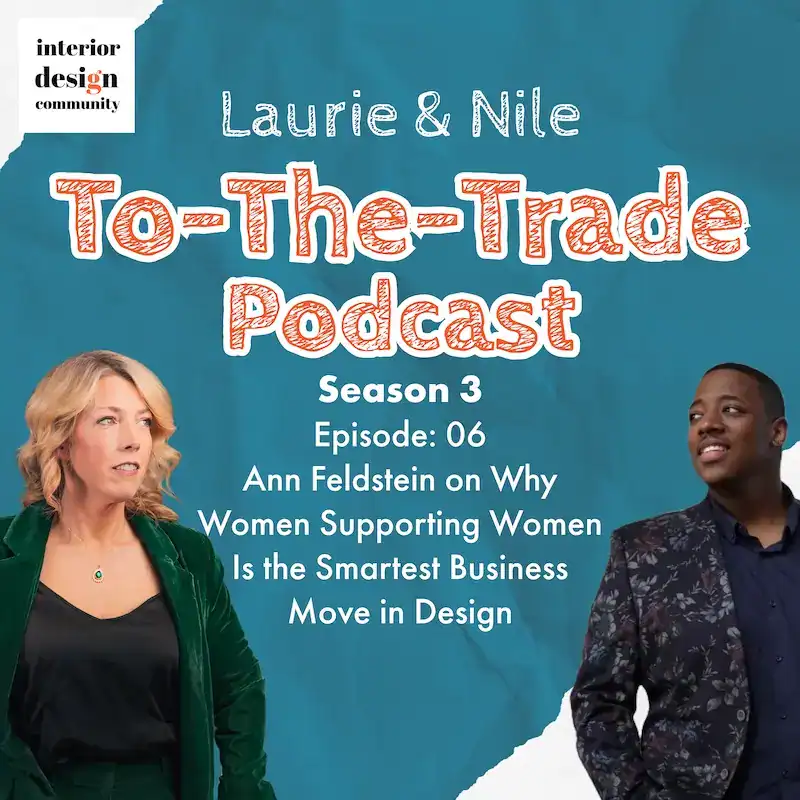
On this episode of To-The-Trade, Ann joins Laurie Laizure and Nile Johnson for a conversation about why women in interior design are often hard on other women, where that pattern comes from, and what practical steps designers can take to change it. The discussion is grounded in Ann’s research-backed presentation on internalized misogyny, which she has delivered at Kravet and other industry events, drawing from sources like Psychology Today and Harvard Business Review.
Where the Pattern Starts
Ann defines internalized misogyny as the tendency for women to project societal biases onto other women, often without realizing it. She traces the roots back to childhood messaging, from fairy tales built on female rivalry to body image standards that leave no version of “enough.” The conversation connects these patterns directly to how they show up in the design business: reluctance to share pricing, suspicion of competitors, judgment at trade shows, and the mental load that quietly drains energy designers could be putting into their firms.
Laurie shares the example of designer Shelly Hudson, who runs a text group of roughly 15 direct competitors in the Hermosa Beach area. Shelly has been a guest on To-The-Trade, where she discussed building her studio from the ground up, and the same spirit of openness drives her competitor group. Members share proposals, pricing, resources, wallpaper installers, and even intel on prospective clients. Those who take more than they give get weeded out. The result is not a race to the bottom. It is a group of designers who have raised their prices, tightened their systems, and strengthened their businesses by operating with full transparency.
The Confidence Gap
Ann draws on her 12 years as a CrossFit coach and gym co-owner to illustrate a pattern she sees in the design trade every day. She consistently had to tell women to add more weight to the bar because they underestimated their own strength. Men, by contrast, almost always had to be told to strip weight off. That dynamic mirrors how designers price, present, and advocate for themselves. Women undercharge, over-explain, apologize before speaking, and soften their authority, often because they have been penalized for being too direct.

Laurie reinforces the point with a story from early in her career. She was pulled into a meeting and told she was not friendly enough because she did not walk the floor saying good morning to male managers each day. No male manager had ever done the same for her. The double standard was clear, and it is one that many women in the trade still navigate.
Who Gets the Authority?
Nile offers a perspective that both Ann and Laurie affirm throughout the episode. He notes that everything he learned about business came from women, and that the design industry, where 85% of Interior Design Community’s audience is female, would benefit enormously if women were given the recognition and authority they have already earned.
Laurie raises the AD100 as an example. Despite the overwhelming number of women practicing interior design, the gender split in prominent industry lists and panels still skews male. Ann references writer Elise Loehnen and the term “manel,” the phenomenon of male-dominated panels in industries where women are the majority. The conversation also addresses what happens when husbands join successful design businesses and try to restructure operations that were already working, a scenario Ann has seen repeatedly through her client work at Moxie.
The Mental Load and What Designers Can Do Now
The episode covers the mental load in detail. Ann and Laurie discuss how women are expected to manage households, families, schedules, and emotional labor on top of running businesses. These expectations carry real costs: time, energy, and earning capacity. For designers already stretched across client work, procurement, and project management, the cumulative weight is significant. If you have ever felt the pull of people pleasing and the cost of automatic yeses, this conversation will resonate.
Toward the end, the conversation turns to action. Laurie announces plans to write personal letters to 10 designers a month, acknowledging their work and reinforcing that they are seen. She also mentions IDC’s 15% profit challenge, a monthly initiative with 300 signups aimed at helping designers strengthen their pricing and business operations together.
Ann’s closing point is simple. Whenever you have the chance to support or elevate another woman in the trade, take it. Remove the judgment. Share the information. Build confidence. It benefits everyone.
Timestamp Guide
00:00 — Introduction and Ann Feldstein’s background
02:08 — Women’s buying power versus representation in design leadership
03:34 — Shelly Hudson’s competitor text group and how transparency strengthens business
05:40 — Internalized misogyny defined and how it shows up between women
06:33 — Elizabeth Blitzer sharing proposals and rates openly
08:06 — IDC’s room-by-room design time poll and industry pricing transparency
09:20 — The designer charging $50/hour and what the room said
11:53 — The mental load and invisible labor women carry
15:11 — Early messaging, fairy tales, and body standards
18:13 — Honor society gender shifts and ego dynamics
21:42 — Matriarchal thinking and centering community over individual gain
22:42 — Melinda French Gates’s book and elevating women to solve systemic problems
25:25 — Women apologizing and downgrading their authority before speaking
26:35 — Laurie’s early career story of being told she was not friendly enough
30:43 — Catching yourself judging other women and what to do about it
34:28 — Giving grace instead of judgment
37:19 — Not one size fits all in business models
37:49 — Loneliness, the third place, and why community matters
40:07 — Ann’s CrossFit coaching analogy: women underestimate, men overestimate
42:34 — The core takeaway: elevate and support women at every opportunity
42:42 — AD100 gender imbalance and the “manel” phenomenon
46:22 — Husbands joining successful design businesses
49:18 — Media double standards and women’s economic power
51:31 — How men can advocate and build women’s confidence
52:44 — Laurie’s plan to write personal letters to 10 designers a month
54:33 — IDC’s 15% profit challenge