

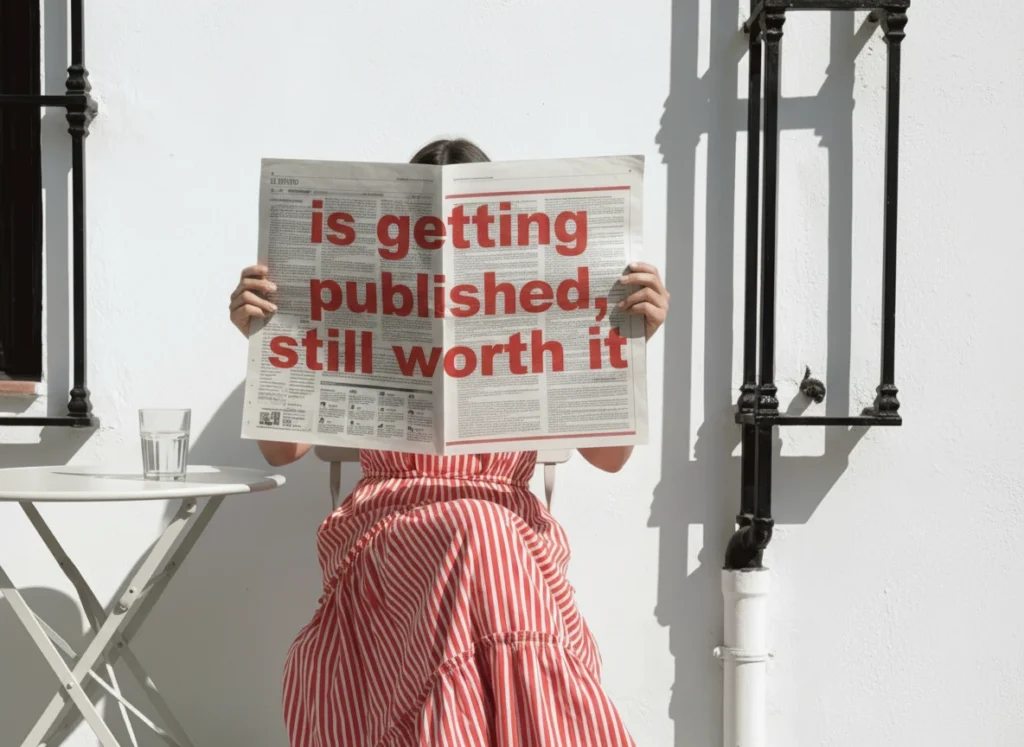
The IDC community weighs in on print press, pay-to-play publishing, and what actually brings in the clients designers want.
You’ve done the shoot. Styled every surface, borrowed the art, held it at just the right angle for the photographer. The feature goes live in a glossy regional magazine, and you wait. You share it on Instagram. You print a copy for your office. Your mom frames one. And then not much happens. No flood of inquiries. No dream clients sliding into your DMs. The phone doesn’t ring any differently than it did before.
Sound familiar? You’re not imagining it.
The question of whether print magazine features still matter surfaces in the design industry periodically, and for good reason. A recent article in Business of Home asked whether designers still care about being published in print at all. Interior Design Community put that question directly to the #idcdesigners community, and what came back was a thread full of candor: equal parts nostalgia, pragmatism, and a few firmly held opinions about who the print world actually serves.
The short answer is: it depends. The longer answer is what this post is about.

What the Question Is Really About
When designers talk about being published, they’re actually talking about several different things at once. There’s the emotional dimension: the validation of having your work recognized and shared publicly. There’s the credibility dimension: the perception from peers, vendors, and prospective clients that your work is notable. And there’s the business dimension: whether any of this actually translates to new clients and revenue.
These three things don’t always point in the same direction. That disconnect is exactly what came through in the IDC thread.
I love it so much, it feels so fancy and its a client confidence builder but not lead generator. 🏯
@ggemdesign
That split, confidence builder on one hand and lead generator on the other, is the core tension that every designer has to resolve for their own practice. The IDC community’s responses make clear that many designers are still wrestling with exactly this distinction, years or even decades into their careers.
The business case for pursuing print publication has gotten harder to make over the last decade. Magazine circulations have declined. Most publications have moved toward hybrid models where editorial and advertising are deeply intertwined. Many designers now describe the process as “pay to play,” meaning the only reliable path to a feature is through financial relationships, either directly with the publication or with the vendors who advertise in it.
The Pay-to-Play Problem
The IDC community had a lot to say about the mechanics of how print features actually get assigned. The picture they painted wasn’t flattering.
I think most of it is pay to play. Mid career I worked for a Top 100 AD designer and she was published all the time because she specified from vendors who advertised in Architectural Digest, so in a sense, pay to play. One client had specific concerns about outdoor furniture and I had made a suggestion for a high end lifetime brand and she nixed it because they didn’t advertise in AD, instead used a non viable outdoor option and that was something that stuck with me.
@vellaartandinteriors
That’s not just about magazine access. That’s about product specification being driven by advertising relationships rather than what’s actually best for the client. It’s a downstream consequence of the pay-to-play system that has implications well beyond PR strategy.
The gatekeeping extends to geography. For designers outside major metropolitan areas, national print presents additional barriers that most industry conversations don’t acknowledge openly. If your firm isn’t in a city where the magazine has editorial offices, if your clients aren’t celebrities, and if you haven’t built a massive social following, the path to a national feature is narrow regardless of how strong your work is. Local and regional publications are simply more accessible, and as it turns out, often more relevant to the clients you’re actually trying to reach.
There’s also the matter of what it actually takes to get published. Most publications expect photography that meets their visual standards, and that means professional shoots, often with borrowed art and styled vignettes that don’t reflect how the client actually lives in the space. Designers who pursue national features frequently invest in staging that exists purely for publication, which raises real questions about the authenticity of the work being presented.
Does Print Actually Bring in Clients?
The community was largely skeptical, especially about national publications. But the answers got more nuanced when the conversation shifted to local and regional press.
In the decades I’ve been doing this magazines don’t bring in clients. In fact, I’ve gone to meet with prospective clients who had magazine tears or pins of our work and they didn’t know it or they played dumb like really dumb. Social media has been far more effective. The whole pay to play with magazines which are now just advertorials with the photographers in on it … word of mouth still better than magazines in my opinion.
@meredithheroncollection
That anecdote about clients who had literally pinned a designer’s work without recognizing them is striking. It suggests that even when a publication reaches the right audience, attribution often doesn’t follow. A reader can admire a room, tear out the page, and pin it to their inspiration board without retaining any information about who designed it.
That’s not a knock on the photography or the design. It’s a structural feature of how print media consumption works. Magazines are aspirational objects. Readers flip through them for inspiration, not for contractor recommendations.
I’ve never actually landed a client from it. It’s flattering to be featured, but it doesn’t necessarily translate to success. Local publications resonate more with me there’s a real chance of connecting with clients in a specific area. Online articles, on the other hand, seem to offer more practical value through SEO. Print just doesn’t carry the same return. I don’t appreciate the pay to play game either like AD pro. Publications are rewarding following and followers to buy in. Magazine use to be the tastemakers, that’s just not the case anymore.
@bryanfrostinteriors
The SEO point deserves more attention than it typically gets in these conversations. When a designer is featured in an online article, even a smaller publication, that article can drive organic search traffic for years. Someone searching for “interior designers in [city]” or “transitional style living room ideas” might land on that article long after it was published. Print doesn’t work that way. Once the magazine issue is off the stands, the feature is largely invisible to prospective clients who aren’t already subscribers. For a broader look at where clients are actually coming from right now, IDC’s post on acquiring new clients beyond Instagram is worth a read.
Where Local and Regional Press Plays Differently
There’s a meaningful distinction between national publications and the local and regional magazines that serve specific markets. Multiple designers in the IDC thread noted that local print had meaningfully contributed to their business, precisely because the audience is the same pool of people who might actually hire them.
I write pretty frequently for a local magazine & it brings in a lot of clients, highly recommended offering content to smaller mags your clients are likely to be flipping through. A national/big mag print feature has always been a goal but it’s more of a personal goal now than a practical business one, I have been told the national press doesn’t necessarily translate to directly to new business/clients but it gives you more cache. In a season where that’s not what I’m focused on!
@northshireliving
The distinction she draws between a personal goal and a practical business one is worth sitting with. Those aren’t the same thing, and conflating them leads to strategic decisions that don’t serve the business. Pursuing a national feature for its prestige is a legitimate choice. Pursuing one, expecting it to generate a pipeline of ideal clients, is likely to disappoint.
Contributing editorial content to a local publication, as @northshireliving does, is also a more sustainable approach than waiting for a feature assignment. It builds a relationship with the publication over time, positions the designer as a subject-matter resource, and tends to generate content that’s genuinely useful to the readers, which is the kind of thing that actually makes someone pick up the phone.
The Emotional Dimension Is Real, and Worth Examining Honestly
Several designers in the thread were candid about the emotional pull of being published and equally candid about what it delivered in practice.
I think the thing that matters most probably to all of us is that getting published, i.e. being recognized for our work, makes us feel really good. It makes us feel successful and that our work means something to other people. Unfortunately, I feel like most publicity nowadays, including most quality, regional design magazines, is all pay to play and that’s not really recognition after all. The things that matter most to me are getting amazing, authentic reviews from clients and builders that I work with. I found that they are ultimately the ones that get me more work for the people and jobs that I love the most 🙂
@kateanderssonstudio
That reframe is worth pausing on. If what a designer actually wants from publication is the feeling of being recognized, it’s worth asking whether there are other sources of that recognition that also produce business outcomes. Authentic client reviews, referrals from builders and contractors, and peer acknowledgment within the industry all provide recognition that compounds over time rather than fading when the next issue arises.
The desire to be published is not a character flaw. For most designers, it’s tied to a genuine love of the work and a wish to see that work reach a wider audience. The question is whether the current mechanisms of print publication are actually delivering that outcome, or whether the effort and expense are producing something closer to a paid credential with limited downstream value.
What to Do With This
The IDC community’s responses point toward a practical framework for thinking through the pressing question.
For national print, the honest assessment is this: unless you have access through location, client profile, or vendor relationships, and unless the cost of photography and, potentially, a publicist makes sense relative to the likely return, the business case is hard to make for most designers. The prestige is real, but it’s priced accordingly and doesn’t reliably convert to clients.
For local and regional print, the calculation shifts meaningfully. A publication that genuinely reaches the homeowners in your market is worth pursuing, especially if the barrier to entry is a contributed article rather than a paid feature. Readers of a local lifestyle magazine are potential clients. Readers of Architectural Digest are mostly aspirational browsers.
For online press, the compounding SEO value is the clearest argument for investing in media relationships. An article that lives online and continues to surface in search results long after publication is doing ongoing work on your behalf. That’s a form of leverage that print simply doesn’t offer. If you’re thinking about how to allocate your marketing time across channels, the IDC post on social media time budgets for interior designers offers a practical framework to help you make that call.
For the day-to-day business of finding and keeping clients, the thread kept returning to the same answer: word of mouth and authentic reviews.
Never pay to be published customers can smell a paid feature a mile away. Being published in magazines I’ve found is only helpful for peer groups or for vendors. Customers don’t really care that much word of mouth and customer reviews matter much more to them.
@citron_date
The peer group and vendor benefits are worth mentioning, because they’re real. Publication in a respected trade or regional publication signals competence and market positioning to other industry professionals. That can support vendor relationships, referral networks, and collaborative opportunities in ways that don’t always show up directly as new client inquiries but still matter to a growing practice.
The Practical Takeaway
Print magazine publication has always meant different things to different designers. What’s shifted is the ratio of what it costs to what it reliably returns.
If you’re pursuing national press, go in clear-eyed about the prerequisites: geography, client profile, advertising adjacency, or some combination of these. Know what you’re actually buying when you invest in the photography and the pitch.
If you’re building a local practice, local media relationships are genuinely worth cultivating. The audience is right, the access is more attainable, and contributing content is a more sustainable path than hoping for a feature assignment.
If your goal is new clients, the IDC community’s experience consistently points to one place: the people who already know your work. Word of mouth from satisfied clients, contractors, and builders is the thread that runs through nearly every answer in this discussion. It’s less glamorous than a magazine credit and harder to photograph, but it’s what actually moves the business forward.
The tastemaker role that major print publications once held has genuinely shifted. How you respond to that shift, and what you decide to pursue in its place, is one of the more important marketing decisions a working designer makes.
Find IDC content more easily in Google
Set Interior Design Community as a preferred source in your Google settings and we’ll show up more often when you search. It takes less than a minute.
Add IDC as a preferred source →
As a Western Pops artist, who just invested a bunch of bucks in advertising in Cowboys & Indians and Western Art & Architecture magazines, I find this very interesting. I’ve sold the painting from WAA May/June. The collector emailed a pic of the magazine page to the gallery in Jackson Hole with her query.
And, a few years ago, three collectors showed up for my solo show at a gallery in Saint Joe, TX, wanting to buy my paintings and saying they had found me in a national magazine. I like that cause and effect. I’m hoping the exposure will mean more people know my work. And my name. I’ve invested in two more ads in each magazine. We’ll see.